

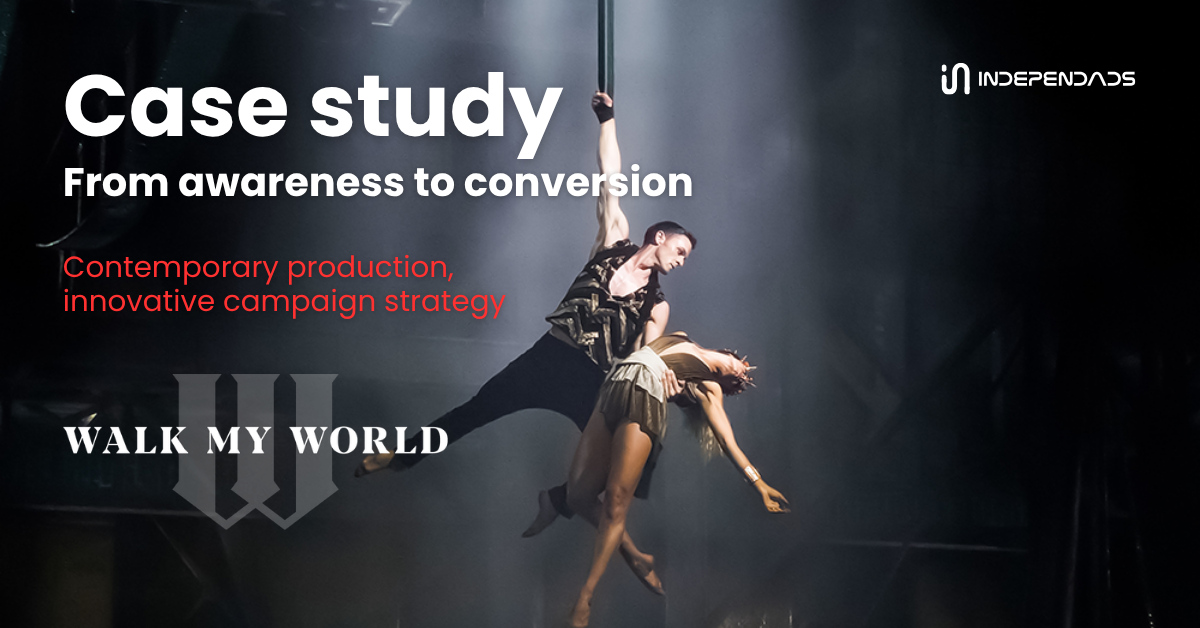
In the first phase of the Walk My World campaign, we saw how raising awareness can be transformed into a genuine brand experience through data-driven tactics and strategic frequency management.
However, the story didn’t end there: Recirquel’s new production not only set the audience on a digital journey, but also encouraged them, step by step, to engage more deeply and, ultimately, to purchase tickets. In the next instalment, we’ll show how we continued to build interest during the Consideration phase and how we converted this into actual sales during the Conversion phase.
Overcoming the Messy Middle: Optimised for Commitment
The consideration phase is the most critical stage of the digital purchasing decision journey: this is where the ‘Messy Middle’ phenomenon, as defined by Google, comes into play, when users compare options, gather information, browse, and do not yet know when they will make a decision. This stage is not linear; the campaign must maintain a constant presence to ensure the brand remains part of what is known as ‘mental availability’.
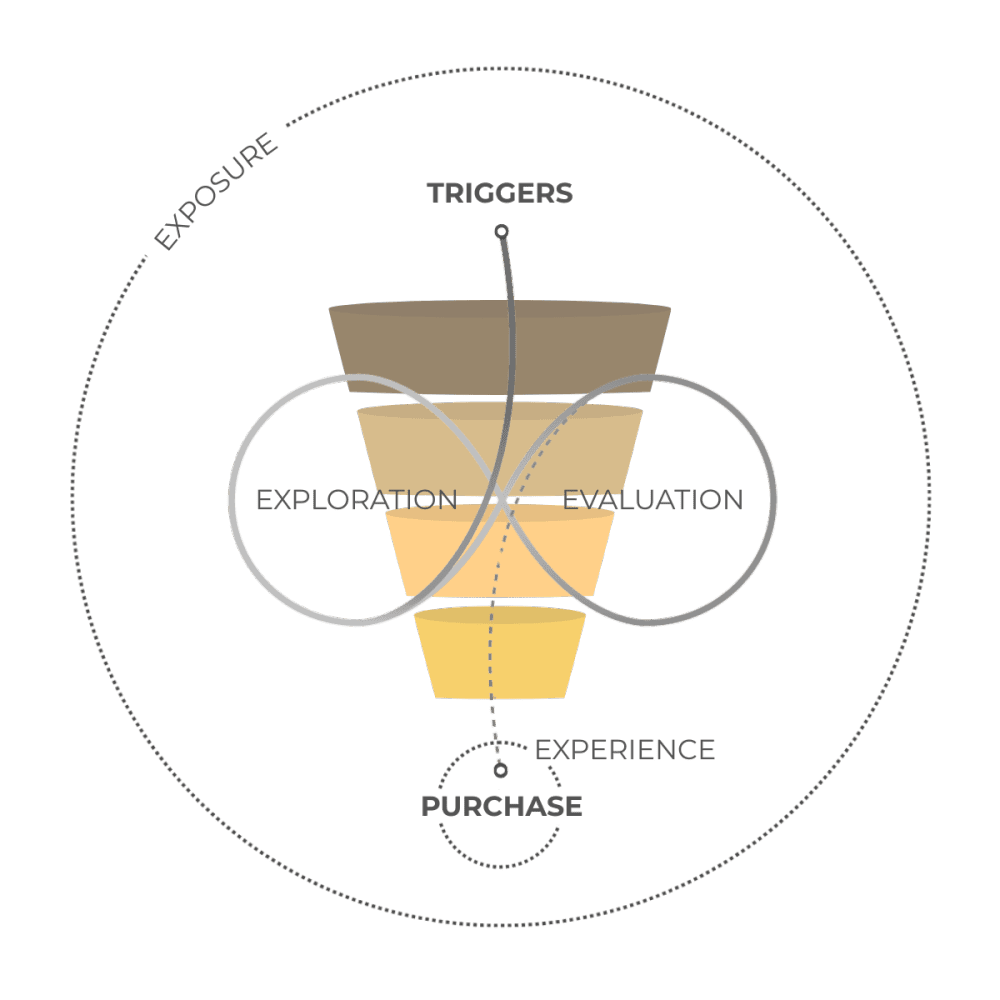
At this stage of the campaign, traditional marketing metrics, such as click-through rate or number of impressions, do not, on their own, provide sufficiently valuable feedback. Of course, it is possible to set impression and click targets, but at this stage advertisers are no longer simply looking for traffic or random clicks; rather, they are seeking interactions that show clear signs of purchase intent. Therefore, in the consideration stage, we optimised the campaign not to maximise CTR, but to strengthen user engagement.
When measuring engagement, we defined three key metrics:
- the visitor spends at least 30 seconds on the website
- the visitor must watch at least half of the teaser video on the homepage
- the visitor must click through to the ticket purchase section
Why is CTR not enough?
In online marketing, the click-through rate (CTR) is one of the most widely used metrics. The formula is simple:
CTR (%) = (Number of clicks / Number of impressions) × 100
CTR is easy to understand, quick to analyse, and at first glance gives a good indication of how appealing an advert is to the target audience. A high value generally indicates that the creative is relevant and grabs attention.
The problem is that CTR tells us nothing about the quality of the click. We cannot tell from it whether the visitor was genuinely interested in the product or service, or whether they simply clicked out of curiosity and then immediately closed the page. Campaigns optimised purely for clicks can therefore easily attract irrelevant traffic, which does not help to achieve the business objective.
Why is the engagement-based approach more valuable?
Site engagement is a metric that measures the depth of actual interaction with a website. This may include time spent on the site, the number of subpages viewed, video view rates, or specific actions such as clicking on internal site links or navigating to the ticket purchase section.
The advantage of engagement-based optimisation is that it not only attracts visitors but also directs a higher proportion of users to the site who are genuinely interested and likely to make a purchase later on. This directly supports conversion goals whilst filtering out superficial, ‘low-value’ visitors.
In short: in the consideration phase, the focus is no longer on quantity but on quality. The question is not how many people click, but who are the people who continue to engage actively with the brand after clicking, thereby moving closer to making a purchase.
Channels used: programmatic display and native
Building on the experience gained from previous campaigns, we focused on two key channels during the Consideration stage: programmatic display and native ads. This combination proved effective, generating over 20,000 clicks, which were accompanied by an average engagement rate of 53 per cent. In other words, roughly one in every two clicks resulted in genuine engagement, such as longer time spent on the page or further interaction.
The release of the creatives was also aligned with the campaign phases, allowing for the parallel testing of multiple formats and versions. Based on the results, certain HTML5-based adverts performed exceptionally well: some variations achieved engagement rates of over 85 per cent, significantly outperforming the results of traditional, static JPG formats. In addition to the static and HTML5 versions, we also utilised Google’s ‘Optimised’ creatives, launched last year, as well as native adverts running on the Taboola network, which also helped to boost audience engagement.
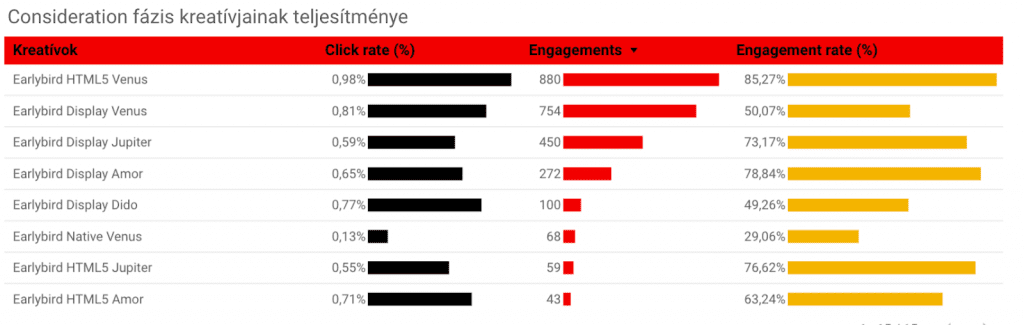
The performance of the creatives in the consideration phase
Optimised Creative is an AI-powered ad format offered by Google Display & Video 360, which is capable of dynamically displaying the best-performing creative variant in line with the campaign’s current objectives. The system selects the most suitable variation from the available creatives in real time, taking into account, for example, engagement or conversions as primary KPIs. The machine learning algorithm running in the background continuously refines the ad displays, testing and combining individual elements – such as images, headlines or CTA buttons – to ensure that every user sees the version that is most appealing to them.
Anyone who has previously used the Responsive Display Ads format on the Google Ads platform will be familiar with how it works; however, this solution will only be available within DV360 from September 2024.
One interesting finding during the Walk My World campaign was that, although the format is highly advanced from a technological point of view, it did not always prove ideal for the target audience. The reason for this is that the system does not always select the most eye-catching or aesthetically pleasing creative; instead, it often simply displays a text message. We had achieved good results with this approach in previous campaigns, so we did not abandon it entirely; however, creatives designed specifically for the consideration phase – mainly in HTML5 format – performed significantly better this time than the Optimised Creative adverts.
Insight #1: The aim of the consideration stage is not conversion, but to build ‘engagement’. Those who remain in this stage for a long time are more likely to convert in the future.
A Chain of Coincidences: The Practical Application of Markov Chains
A Markov chain is a mathematical model that helps to model user behaviour as they transition between different states. In the case of Walk My World, we have defined the following states:
1 Awareness: The user is familiar with the Recirquel company and its performances.
2 Consideration: The user is considering purchasing a ticket for the performance.
3. Conversion: The interested customer purchases a ticket for the performance.
No Conversion: The interest does not result in a conversion; in other words, the user does not end up buying a ticket for the performance.
We can also demonstrate the campaign’s effectiveness using Markov chain logic, where we progress from reach, through clicks and engagement, to conversion.
Imagine that nearly two million people stop for a moment in front of a huge arena. We have reached them with our adverts. The majority simply glance at the lights and the posters before moving on, but twenty thousand decide to step closer to the entrance – these are the clicks.
More than ten thousand of them also take the time to watch what is happening inside at greater length: they observe attentively, soak up the special atmosphere, and become truly engaged with the production. It is these interested individuals who will become the eventual ticket-buyers, who will cross the threshold during the premiere period, thereby entering an immersive world where they can explore the Walk My World experience for themselves. It is this digital journey that truly demonstrates how curiosity turns into commitment, and then into genuine cultural participation.
The Markov chain has therefore been modified as follows:
- Awareness / Reach – the ~1,953,822 people standing in front of the arena
- Interest / Clicks – 20,000 people who moved closer to the entrance
- Consideration / Engagement – 10,000 people who immersed themselves in the world of the performance
Insight #2: The click/engagement rate is a critical point in the decision-making process: this is where it is decided whether curiosity deepens or users drop out. The 53 per cent engagement rate achieved is outstanding, exceeding even our own advertising benchmark by 51 per cent.